 Retrieval-Augmented Generation (RAG)
What is RAG (Retrieval Augmented Generation)?

Retrieval-Augmented Generation (RAG)
Maximize your business value:
What is RAG (Retrieval Augmented Generation)?
Retrieval-Augmented Generation (RAG) is an advanced artificial intelligence technique that combines generative models, such as large language models (LLMs), with information retrieval systems. This approach allows models to generate more accurate and relevant text by integrating external data during the generation process.
RAG operates by first retrieving relevant documents or data points from a large corpus based on a user's query or prompt. This retrieval step ensures that the model has access to up-to-date and contextually appropriate information, which is particularly beneficial in fields where knowledge rapidly evolves, such as technology and medicine. This information improves contextual grounding when generating text. RAG is established by the premise that makes use of this external data to create richer, factually-grounded output while maintaining coherence.
RAG has a typical architecture with two components: a retriever and a generator. The retriever identifies and pulls pertinent information from a database, and the generator uses this information to construct a coherent response. This dual mechanism allows RAG to overcome some limitations of traditional generative models, which may produce plausible-sounding but factually incorrect information when relying solely on their training data.
RAG has vast applications within chatbots, virtual assistants, and content creation tools. Because it produces more relevant, context-aware replies, RAG can increase user satisfaction and user experience significantly. As businesses continue to adopt AI-enabled solutions, the importance of retrieval-augmented approaches in delivering trustworthy user-facing content across platforms will grow significantly.
Benefits of RAG
Real-time data utilization
RAG allows companies to leverage up-to-date information from external databases or knowledge bases, ensuring that generated content reflects the latest industry trends, product updates, or regulatory changes.
Reduction of hallucinations
Traditional generative models often produce fabricated or inaccurate information (known as "hallucinations"). RAG reduces this issue because the generation is based on verified external data which leads to more trustworthiness.
Support for complex queries
RAG excels at handling multifaceted questions that require synthesizing information from multiple sources. This capability is particularly beneficial in sectors where inquiries can be intricate and data-driven.
Efficient knowledge management
By integrating RAG into knowledge management systems, companies can streamline internal processes, allowing employees to access comprehensive, contextually relevant information quickly, thus improving decision-making.
Improved training data
RAG can help organizations refine their AI models by continuously providing high-quality, contextually relevant training data, which can enhance the overall performance of other AI applications within the company.
Facilitation of research and development
RAG can assist R&D teams by retrieving the latest research findings or competitive intelligence, enabling faster innovation cycles and more informed product development strategies.

Retrieval-Augmented Generation (RAG) - Globant’s Approach
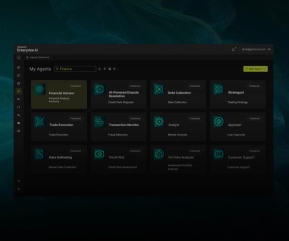
Globant can help companies take advantage of Retrieval-Augmented Generation (RAG) technology through our Globant Enterprise AI platform, designed to integrate generative artificial intelligence agents and assistants without the need for programming. This platform is a powerful solution for transforming business processes and maximizing the value of internal data through the use of large language models (LLMs) combined with vector databases.
- Contextualized and Precise Responses: RAG allows generative models to use company-specific data, such as manuals, policies, or reports, to deliver highly relevant responses. This improves accuracy and reduces the need to retrain models by simply updating documents in the database.
- Multimodality: Globant Enterprise AI supports multimodal capabilities, which means that it can process text, audio, video, and images. This opens up new opportunities for automating processes and personalizing user experiences.
- Operational Optimization: Companies can transform processes such as customer service, financial analysis, or document management through RAG-based agents.
With Globant Enterprise AI, organizations have access to a comprehensive solution that combines technological innovation with a practical approach to solving business challenges through advanced artificial intelligence.
More about RAG
Frequently Asked Questions
How does RAG work?
Retrieval-augmented generation (RAG) operates by combining two core processes: information retrieval and text generation. Initially, when a user inputs a query, RAG retrieves relevant documents or data points from a pre-defined knowledge base or external sources. This retrieval process ensures that the model has access to accurate and contextually relevant information. Subsequently, the generative model synthesizes this information to produce coherent, contextually appropriate responses. By integrating real-time data into the generation process, RAG enhances the quality and relevance of the output, making it particularly effective for applications requiring accurate information.
What are the main components of RAG?
RAG consists of three main components: the retriever, the generator, and the knowledge base.
• Retriever: The retriever is responsible for identifying and extracting relevant information from various data sources based on the user's query. This component employs sophisticated algorithms to ensure that the most pertinent data is selected, enhancing the relevance of the responses generated.
• Generator: Once the relevant information is retrieved, the generator processes this data using advanced language models. It synthesizes the retrieved content to create coherent and contextually appropriate text, ensuring that the output aligns with the user's intent and query.
• Knowledge Base: The knowledge base serves as the repository of data from which the retriever pulls information. It encompasses both structured data (such as databases) and unstructured data (such as documents), providing a comprehensive foundation for the retrieval process.What types of data sources are typically integrated with RAG systems?
RAG systems can integrate a diverse array of data sources to enhance their performance. Common sources include structured databases, such as customer relationship management (CRM) systems and enterprise resource planning (ERP) systems, which provide organized information. Additionally, unstructured data sources like web pages, research articles, and knowledge bases are often utilized to enrich the context for the generative model. APIs from third-party services can also be integrated to access real-time data, such as news feeds or industry reports. This variety of sources allows RAG to deliver comprehensive and nuanced responses tailored to specific queries.
What are the key advantages of using Retrieval-Augmented Generation (RAG)?
Retrieval-Augmented Generation (RAG) technology offers businesses a variety of vital benefits. RAG improves accuracy and relevance with the contextualized incorporation of external data to reduce incorrect or outdated information. RAG improves accuracy and contextualized relevancy of the information generated by the language models. It also improves user interaction, which improves personalized and relevant experiences for the user. Lastly, RAG increases decision making and organizational effectiveness through relevant, timely access to information, which is essential in a highly dynamic business context.