Why AI Agents Need Governance
As AI agents operate across enterprise systems, data, and workflows, governance becomes essential to ensure their actions remain within defined boundaries. Without proper controls, organizations risk unauthorized access, unexpected execution, inconsistent outcomes, and limited accountability.
Governance establishes the policies, permissions, and oversight needed to manage these risks, while observability provides visibility into agent activity and execution. Together, they help enterprises maintain control, build trust, and scale AI operations responsibly.
What Is AI Agent Governance?
AI agent governance is the framework of policies, controls, permissions, and oversight mechanisms that define how AI agents operate within an organization. It establishes what agents can access, which actions they can perform, how they interact with enterprise systems, and when human intervention is required.
An enterprise AI governance framework helps organizations manage AI capabilities across their lifecycle, from model selection and agent configuration to execution, monitoring, and continuous improvement.
Effective governance considers several dimensions:
- Access and permissions: Define which data, tools, applications, and systems agents can access.
- Execution boundaries: Establish the tasks agents can perform, the limits of their autonomy, and when actions require approval.
- Data governance: Ensure agents work with authorized information and respect organizational data policies.
- Model governance: Manage model selection, usage, and the requirements associated with different AI capabilities.
- Human oversight: Establish accountability, validation mechanisms, and escalation paths for decisions or outputs requiring human judgment.
- Traceability: Maintain visibility into AI activity to support reviews, investigations, and operational accountability.
These controls help organizations move from isolated AI experiments to governed enterprise AI environments where autonomous execution operates within defined business and technical boundaries.
Governance Controls for Enterprise AI Agents
Effective AI governance starts with defining what agents can access, what actions they can perform, and where their autonomy ends. These boundaries help organizations manage risk without restricting AI capabilities unnecessarily.
Governance controls should establish:
- Access permissions: Which data, systems, and tools agents are authorized to use.
- Execution boundaries: What agents can do, which actions are restricted, and when approval is required.
- Data protection: How enterprise information is accessed, handled, and protected.
- Human oversight: When human review, intervention, or approval is necessary.
These controls create a framework for enterprise AI governance, helping organizations strengthen AI agent security while keeping execution aligned with business requirements.
AI Agent Observability: Visibility into Execution
Governance defines the rules under which agents operate. Observability helps organizations understand what happens during execution.
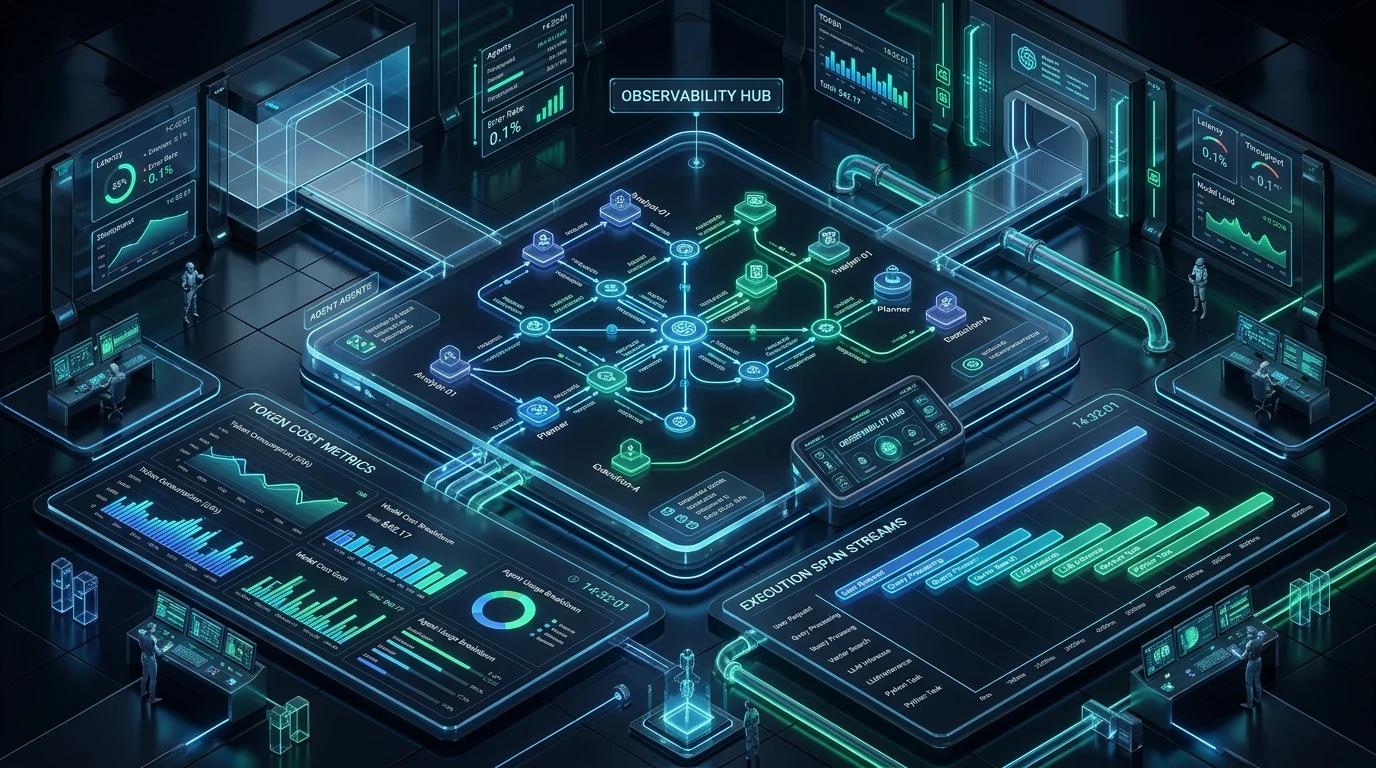
AI agent observability provides visibility into agent activity, interactions, decisions, and execution paths. Unlike traditional software monitoring, which often focuses on predefined metrics and system performance, AI observability must also account for dynamic behavior, model interactions, context, and generated outputs.
AI agent monitoring helps organizations investigate how tasks are performed, identify unexpected behavior, understand execution failures, and evaluate whether agents are operating as intended.
Depending on the architecture, observability may involve examining:
- Agent activity and task execution.
- Model selection, routing, and interactions.
- Workflow progression and dependencies.
- Token consumption and resource utilization.
- Outputs, validation results, and failures.
- Human interventions and approval events.
This visibility is particularly important when multiple agents, models, and enterprise systems interact. Without sufficient context, identifying where an issue originated or understanding why a workflow produced a particular outcome becomes increasingly difficult.
AI observability helps transform execution into something organizations can inspect, evaluate, and continuously improve.
What Enterprises Need to Monitor
Effective AI agent monitoring goes beyond checking whether an agent completed a task. Enterprises need to understand how resources are consumed, how workflows progress, where execution breaks down, and whether outcomes meet expectations.
Monitoring model usage and routing can help teams understand which models are being used, how AI requests are distributed, and where changes in model selection may affect execution or consumption.
Token and cost visibility is equally important. As AI adoption expands across teams and workflows, organizations need to understand usage patterns, attribute costs, establish budgets, and identify opportunities for optimization.
Workflow monitoring helps reveal bottlenecks, incomplete tasks, recurring failures, or dependencies that affect execution. Reviewing outputs and validation results also provides insight into quality, consistency, and the need for human intervention.
These monitoring dimensions give enterprises a more complete understanding of AI operations, supporting informed decisions about performance, resource allocation, and the evolution of their AI ecosystem.
Validating AI Agent Execution
AI agent observability provides visibility into execution, but validation ensures outputs meet defined quality standards. Traceability and automated checks help identify discrepancies, review results, and detect issues before they move forward.
In Glob.AI AI Pods, validation combines automated checks, agent reviews, and human expertise. Forward Deployed Engineers (FDEs) review and approve outputs before they reach the client environment, while client acceptance adds another layer of accountability.
This approach connects execution with quality control and accountability. Instead of treating validation as a final checkpoint, it becomes part of the delivery workflow, creating opportunities to identify recurring issues and improve how work is performed.
Human Oversight in Autonomous AI Execution
As AI agents take on more complex tasks, human oversight becomes a fundamental part of the operating model. Autonomy does not eliminate responsibility; it changes how people contribute to execution, decision-making, and quality.
In AI Pods, agents operate as the execution layer, handling tasks through documented workflows. Forward Deployed Engineers provide the judgment layer, defining acceptance criteria, validating outputs, reviewing architecture and reasoning, and approving work before delivery.
Human oversight also contributes to continuous calibration. When failures or inconsistencies are identified, they can inform workflow adjustments and future execution cycles. Knowledge gained through supervision becomes part of the process rather than remaining isolated in individual reviews.
This relationship allows AI agents to handle execution at scale while human expertise maintains quality, context, and accountability.
Governance as a Foundation for AI-Native Delivery
Scaling enterprise AI requires a governance layer that connects models, agents, enterprise knowledge, and execution while maintaining visibility and control.
Glob.AI provides unified governance for model, agent, and coding-agent calls. Its four interconnected hubs bring together the capabilities enterprises need to manage AI across their ecosystem:
- Intelligent Hub: Model access, intelligent routing, failover, and token optimization.
- Corporate Hub: Enterprise knowledge, integrations, and permission-controlled access.
- Agentic Hub: Agent testing, deployment, versioning, and runtime governance.
- Token Vault: Usage visibility, budgets, and cost attribution.
Together, these capabilities connect enterprise AI execution with governance, observability, and control. With flexible deployment options, Glob.AI OS helps organizations scale AI adoption across teams and workflows while maintaining oversight and accountability.

