
Letter to Shareholders
Q3 2026
Nov 19th, 2026
Good afternoon, everyone, and thank you for joining us.
Three headlines today. The annualized run rate of Glob.AI doubled in a single quarter, from $52.8 million in June to $106.6 million in September, and we are raising our year-end target from $110 million to no less than $130 million. Revenue came in at the midpoint of our guidance, with expanded margins, and free cash flow for the first nine months is a record.
Our Board has increased our share repurchase program from $125 million to $250 million, running until December 2027, the largest repurchase program in our history, equivalent to about 13.5% of our shares at current prices.
A year ago I introduced you to AI Pods, an AI-native way of delivering our work, priced on outcomes and consumption rather than hours. Since then, they have become part of something larger: Glob.AI, the platform we released to the market in August and expanded last month with Glob.AI OS. In August I told you this would be a deliberate transition, executed quarter after quarter, and that we would prioritize it over short-term revenue. This quarter shows what that looks like when it works.
I will go through each of these headlines, and then spend some time on how we are changing the way we sell.
Glob.AI results
First: Glob.AI. We welcome its growing share of Globant, because this is the investment thesis I described in August: more work delivered at a higher margin. And the accounts making that happen are growing. Accounts already delivering through Glob.AI grew 5.2% year over year, faster than the rest of the company, and among our mid-sized accounts the difference was sharper: those on Glob.AI grew close to 30%. It is also why the progress underneath is larger than the top line shows.
The quarter
Second, the quarter. Revenue was $611.1 million, in line with the midpoint of our guidance. Outside New Markets, which is currently affected by the situation in the Middle East, Globant grew 1.5% year over year. In August I said the way to read this transition would be revenue per head, Glob.AI margins and client penetration. All three improved this quarter. Revenue per Glober reached a record $99,800 on an annualized basis, up 9.7% year over year. Glob.AI gross margins run about ten points above our traditional delivery. And close to half of our top 20 clients are already delivering through Glob.AI.
The growth is also where we want it. Our 100 Squared accounts, the long-term relationships with major global players that anchor the company, grew 6% year over year and now represent 57% of revenue. Our top 50 clients grew 5.7% and our top 20 grew 5.6%. Growth across our industry studios was led by GUT and by Games and Education, with Healthcare and Media also up. Bookings and pipeline remain at healthy levels across our studios.
Share buy-back
Third, the share repurchase. Our AI-native business is growing at triple digits, our free cash flow is at a record, and our balance sheet is strong. That gives us room to invest in the business and to return capital at the same time. At today's share price, returning capital is clearly accretive, so our Board has increased our share repurchase program from $125 million to $250 million, running until December 2027, the largest in our history. At current prices it retires roughly 13.5% of our shares outstanding, funded from cash flow, while we keep investing in Glob.AI, in our strategic accounts and in the opportunities we are evaluating. Juan will take you through the mechanics.
New Markets
Our New Markets region covering the Middle East, was the one part of the company with lower revenue this quarter, as the situation in the Middle East led clients to reschedule programs until conditions stabilize. Our team and our relationships in the region are intact, and we kept building through the quarter: GUT was selected by Miral Experiences, Abu Dhabi's premier attractions operator, as its preferred agency for 2027 to 2030. We are positioned to resume growth in the region when the situation improves.
How we sell today
Let me spend a minute on how we sell today, because it changed along with the model.
Globant sells in two acts. Our Studios define the challenge inside the client, and Glob.AI solves it. The industry AI Studios and our Core Studios, Digital, Enterprise and GUT, bring the industry knowledge and the craft. Their Delta Teams put Forward Deploy Engineers inside the client, learn how the client actually works, and build the first prototypes in a few weeks. The client sees its own process running with AI before anything scales.
Most of these conversations come down to a few questions. Where can AI move the business the most? Who is going to build it, and how soon? And how does it get out of the pilot and into everyday use, with the data ready, under the client's control, at scale? The Studios answer the first two. Glob.AI answers the last one, which is the step that decides whether an AI initiative pays off.
The effect on our business is practical. Deals close faster, because the client is deciding on evidence rather than on a presentation. The work goes all the way into production, beyond the proof of concept. And we get paid differently: AI Pods are paid by outcome or by consumption, so more of our revenue is tied to what we deliver than to how many people we deploy. Once the Studios have earned the trust, Glob.AI keeps us inside the client's operations. That is our land and expand strategy.
Many of the AI Pods are built with partners: Secure Code Review with Anthropic, Omniverse with NVIDIA and Application Modernization with Vercel, among others.
Glob.AI: platform, clients and partners
We launched Glob.AI, our AI-native platform, in August. This quarter, several large accounts moved existing programs onto the model, and the AI Pods we productized in the spring reached full run rate.
1. Glob.AI OS
On October 27 we launched Glob.AI OS, and it changes what Glob.AI is. Until now we sold AI Pods: outcomes delivered by agents under our supervision. With the OS we also sell the foundation underneath every AI call in a large organization: its three hubs, Intelligence, Corporate and Agentic, plus the Token Vault, which answers, for every call, who used AI, on what data, at what cost and under which policy. It is sold per consumption or outcome, with a minimum yearly or monthly commitment, runs as SaaS or in the client's own cloud, and the client's data remains sovereign. Diego will take you through the models, the Apps and Coda. AI Pods and the OS work best together, and each can be bought on its own. The OS is how a CIO adopts AI across thousands of people while keeping control of it, and every call that runs through it is revenue for us and context for the next AI Pod.
Sarab Narang, who joined in August as CEO of Glob.AI, now runs the platform business end to end. We build with the companies setting the pace in AI, turn their capabilities into products, and deploy them at enterprise scale.
2. Client stories
Let me show you what happens when the model meets real client work.
A European enterprise software company gave one of our AI Pods ownership of a module in its SaaS platform, working alongside about twenty other teams under the same delivery process. In three to four months, velocity rose about 90% and delivery capacity doubled with a comparable team, while quality held. That is capacity scaling without headcount.
At the LA Clippers, AI Pods powered by Glob.AI work across the digital ecosystem behind Intuit Dome: mobile apps, more than twenty backend microservices, IoT systems and over forty third-party integrations. Glob.AI grounds each Pod in the Clippers' architecture, standards and dependencies, and human quality gates stay on every critical output. Well-defined backend tickets went from days to hours. Active mobile unit tests grew 3.6 times. QA report analysis went from two hours to twenty seconds. Features shipped rose 34% half over half.
With Duty Free Americas we designed and built its first proprietary loyalty program for international travelers, following DFA's acquisition of concessions at the Los Angeles, San Francisco and Abu Dhabi airports. AI Pods halved the production time: the MVP is live, with a loyalty engine integrated with DFA's point-of-sale systems, a customer mobile app, digital membership cards and a tool for store associates.
And Atlético de Madrid selected Sportian, the sports technology division of Globant and LALIGA, as its official performance data partner, powered by Glob.AI, for real-time video and data analytics in matches and training.
3. Partnerships
Our partners are a big part of how this scales. Over the quarter they engaged with Glob.AI in two ways: co-building AI Pods with us, with the MuleSoft pod launched with Salesforce in September and SAP and Oracle as the newest releases, and using the platform in their own operations, as Autodesk described at our Glob.AI Sessions. With Anthropic we ran joint executive sessions in Los Angeles, Buenos Aires and London, showing production agentic workflows built on Claude, among them the Secure Code Review AI Pod. One year into our Strategic Collaboration Agreement with AWS, revenue from AWS-related projects grew 45% year over year, the associated run rate more than doubled, and we are adding Sportian to the 18 solutions we already have on AWS Marketplace. In October Vercel named Globant its Global Partner of the Year and Gartner recognized us as a specialist in Physical AI services.
We delivered the quarter we guided: revenue in line, margins up sequentially, record cash flow, and our 100 Squared accounts growing 6%. We enter 2027 with Glob.AI at a run rate of no less than $130 million and up to $250 million going into our own shares. The transformation is no longer something we describe; it is something our clients are running.
Thank you to our clients, our partners and our Globers around the world.

Martín Migoya
Co-founder & CEO
Special Remarks from our CTO
Hello, It’s great to be back with you.
I am very excited to tell you more about how we are completing Glob.AI, our AI-native services platform, by adding Glob.AI OS, a unified governance layer to our AI Pods. This operating system together with our Glob.AI Apps are truly enabling AI Adoption every day.
Glob.AI OS is built around a simple reality: AI moves at machine speed while governance moves at meeting speed. The tenth agent ends up costing as much as the first. Every team connects its own model. Credentials are scattered, and agents get built with no shared lifecycle. Finance can’t say who spent what, and Security has no single place to enforce the rules.
Glob.AI OS provides runtime governance and answers the pressing questions every CEO and CTO faces around AI adoption, from data readiness to cost control.
To solve the cost-versus-value equation with total control, Glob.AI OS Intelligence Hub and Auto Router dynamically match every request across 320+ AI models to the most cost-effective option. Acting as a single gateway across every model and agent call, the platform applies six governance domains, from Identity & Access to Audit & Observability, to regulate agent behavior at runtime rather than after the fact, while Token Vault enforces strict data sovereignty so your corporate knowledge remains yours and never trains external models.
To make AI immediately useful to your people, Glob.AI OS Corporate Hub builds a consolidated enterprise context grounded in business ontologies systematically transforming scattered raw data into structured information, and that into actionable corporate knowledge. Users don't need complex prompts or have to explain that billing lives in one system while forecasts sit in another, the system already understands your company's definitions, assets, and rules in a semantically natural way. Once your people can query business reality effortlessly, the Agentic Hub unlocks the compound effect across your processes turning recurring operational work into governed, automated agent workflows that do the heavy lifting before human review.
With Glob.AI Apps, Glob.AI sits inside your team's workflow putting AI to work across everyday tasks meeting them wherever they work: web, mobile, desktop, CLI, or directly embedded into their usual tools. Your teams can simply chat and get instant answers, run research, and create agents or leverage our proprietary ones. They can delegate to AI and hand off entire tasks and workflows, not just ask a question. Within the apps, users can access our proprietary CODA, which is more than a coding agent, it’s our own harness capable of being adapted to engineer domain specific solutions. With CODA you can create your own solutions and agents.
Glob.AI OS gives the consistency to drive real adoption across an organization. This makes Glob.AI a bigger bet and a more comprehensive solution for any company's AI adoption roadmap. It not only provides enterprise-grade services shipped and charged by outcomes or by consumption, it also becomes an integral part of how your team works every day with AI.
Beyond Glob.AI, our ambition to scale our transformation in how we operate, develop talent, and deliver value involves the entire organization. We want all Globers fully prepared for the AI-native era. We are reshaping how technical expertise is organized and deployed, evolving career paths, scaling AI fluency, and giving our teams direct access to AI that elevates their day-to-day work. A key pillar of this effort is developing a robust Forward Deployed AI Engineer capability across three fronts: accelerating Glob.AI deployment, certifying specialized talent alongside strategic partners like Anthropic, OpenAI, Salesforce, Microsoft, and Google, and shifting our senior technical leadership into a hands-on, consultative front-line posture.
Let me share more great examples on how we are creating value for our clients through Glob.AI and a short overview on how our creative business is performing.
Globant helped Autodesk modernize Autodesk Assemble, software that transforms building information modeling data into actionable insight for preconstruction and construction teams, by integrating AI Pods to accelerate development. Early in the engagement, the team uncovered reusable patterns that automated lengthy phases of software development and significantly cut delivery timelines. The AI Pods gave Autodesk’s engineers the clarity and confidence to take on ambitious projects in a traditional codebase they had not originally authored. The modernization gives Autodesk a stronger foundation to improve Assemble’s performance and deliver new value to customers sooner, and it changed team mindsets, expanding their view of what’s possible when modern AI is applied to legacy modernization.
In Argentina, we worked with YPF to evolve its app into an investment platform, letting users trade YPF shares directly within it. Using Glob.AI and our AI Pods, we delivered the feature in just two months, with 35% greater efficiency in the development cycle and a 25% increase in implementation speed across product, UX, mobile, backend and testing. The result: one million shares purchased through the app, turning thousands of Argentines into YPF shareholders.
GUT had another strong quarter, delivering double-digit growth in revenue vs. Q2. The network partnered with Netflix and AB InBev to launch their first-ever multi-market partnership, bringing "The Gentlemen" and Stella Artois together with Theo James and David Beckham. GUT also debuted new work for Bimbo Artesano and Aeromexico in LATAM, Glovo in the Iberia region, and Google Chrome in the US.
I am proud to see Globant relentlessly building the capabilities to scale value faster than effort toward one powered by expertise, automation, and reusable assets creating the foundation for sustainable growth, stronger differentiation, and a more outcome-driven relationship with our clients.
Thank you very much.
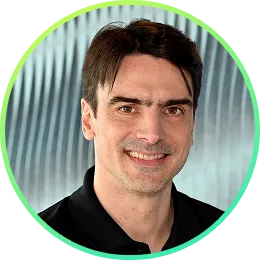
Diego Tártara
CTO
Special Remarks from our CFO
Hello, and good afternoon, everyone.
During the third quarter, revenues came in at $611.1 million, in line with the midpoint of our guided range, and we expanded adjusted operating margin sequentially to 14.1%. We generated $77.2 million of free cash flow, taking free cash flow for the first nine months to a record for the company. We completed the business optimization initiative we announced in August, repurchased $25.0 million of our shares, secured the refinancing of our debt structure, and continued to scale AI Pods, which more than doubled their annualized revenue relative to the prior quarter.
I will take you through revenue, profitability, cash, and then our updated guidance.
Revenue was $611.1 million. Excluding New Markets, revenue grew 1.5% year-over-year. Including that region, revenue was down 1.0% year-over-year and 0.5% sequentially, with 30 basis points of FX tailwind on a year-over-year basis. New Markets revenue was $27.9 million, down 34.2% year-over-year and 16.7% sequentially, which took roughly 235 basis points from group growth.
Latin America was our fastest-growing region, up 8.3% year over year and 4.1% quarter over quarter to $133.1 million, driven by Banking, Energy, and Tech. North America reached $331.3 million (flat year over year, +2.0% quarter over quarter), while Europe was $118.9 million (-0.8% year over year).
Client cohorts remained strong, aligned with our 100-squared strategy. Year-over-year growth included: top 50 (+5.7%), top 20 (+5.6%), clients 11–20 (+8.6%), and top 10 (+4.5%, averaging $19.0 million quarterly). Our largest client grew 11.5% year over year, representing 9.8% of Q3 revenue. The top 20 accounted for 42.5% of total revenue (up from 39.9% year over year), with 17 of 20 growing year over year. Our focus on higher-value engagements and operational efficiency also drove revenue per head to an all-time record of $99.8 thousand, up 9.7% year-over-year.
A key operational highlight in the quarter has been the strong expansion of our AI-native offerings. AI Pods reached an annualized revenue run rate of $106.6 million at the end of September, more than doubling from $52.8 million in June, and up nearly tenfold from $11.3 million a year ago. This puts us well ahead of our original pace, and we are raising our year-end target from at least $110 million to no less than $130 million.
As Martín mentioned, the accounts already delivering through Glob.AI are growing faster than the rest of the company. We are scaling market outreach, which is driving significant new interest across new logos, and our sales engine is successfully moving current engagements onto AI Pods.
Turning to profitability. Adjusted gross margin was 36.8%, up 30 basis points sequentially, as the first savings from the optimization initiative and a better delivery mix offset continued pressure from Latin American currencies. Compared to the prior year, adjusted gross margin was down 130 basis points, primarily driven by FX headwinds. Adjusted SG&A was 18.3% of revenue, down 30 basis points sequentially, as the streamlining and efficiency initiatives continue to yield results. On a year-over-year basis, SG&A is 60 basis points higher, which reflects our targeted go-to-market investments to commercialize and scale the Glob.AI platform.
As a result, adjusted operating margin reached 14.1%, up 90 basis points sequentially and in the upper half of our 13.5% to 14.5% guided range.
On the business optimization initiative: we recorded a $27.4 million charge in the third quarter, bringing the total for the program to $59.7 million. The program is now complete.
Adjusted net income was $63.8 million, a 10.4% adjusted net income margin, up 60 basis points sequentially. Adjusted diluted EPS was $1.48, at the midpoint of our $1.43 to $1.53 guidance, based on 43.2 million average diluted shares. That share count is 5.3% lower than a year ago, reflecting the repurchases we have executed since last September.
Our balance sheet remains strong. We ended the quarter with $153.6 million in cash and short-term investments and $258.4 million in net debt. Gross debt was $412.1 million at the end of the quarter.
As announced, on Oct 29th, we amended our Term Loan and RCF, extending maturity to 2031 and setting our borrowing capacity at $850 million, among other changes.
Cash flow was the standout of the quarter. We generated $94.5 million of cash from operations and invested $17.3 million in capital expenditures, or 2.8% of revenue, down from 4.0% a year ago as we align CapEx with our current level of growth. Free cash flow was $77.2 million, a free cash flow to adjusted net income ratio of 121.0%. For the first nine months of the year, free cash flow reached $125.9 million, up 113.6% year-over-year, a free cash flow to adjusted net income ratio of 66.5%, and the strongest first nine months in the company's history. As always, our cash generation is seasonally stronger in the second half, and we expect another solid quarter in Q4.
This combination of robust cash conversion and extended liquidity profile gives us the financial flexibility to execute on our capital allocation framework. Our focus remains protecting balance sheet flexibility while putting our FCF to work.
Our Board has authorized the expansion of our share repurchase program from $125 million to $250 million, through December 2027. At current trading multiples, our own shares are the best use of our cash. We have been executing: we repurchased $25.0 million of our shares during the third quarter, and our diluted share count is 5.3% lower than a year ago. The program will be funded with free cash flow and selective use of our expanded debt facilities.
Now let me turn to our outlook. It changes for one main reason: the Middle East. We now don’t expect any recovery in the region in Q4. To a lesser extent, there is an incremental knock on effects into travel and hospitality from high oil prices that we now expect in Q4.
For Q4 2026, we now expect revenue between $596 million and $604 million. We project non-IFRS adjusted operating margin of 13.5% to 14.5%, an IFRS tax rate of 21% to 23%, and adjusted diluted EPS of $1.43 to $1.53, assuming 43.3 million average diluted shares.
For FY 2026, revenue guidance is narrowed to $2,429 million to $2,437 million, within the range provided back in August. In terms of profitability, we continue to expect our adjusted operating margin for the full year to be between 13.5% and 14.5%. The IFRS effective income tax rate is expected in the 21.0% to 23.0% range. We now expect adjusted diluted EPS of $5.77 to $5.87, also within the range we gave you in August, assuming 43.5 million average diluted shares.
To conclude: we delivered the quarter we guided, expanded margins sequentially, generated record year-to-date free cash flow, and completed the business optimization that resets our cost base. Our largest clients are growing, AI Pods more than doubled their annualized revenue in a single quarter, and what held back our growth in Q3 was primarily New Markets and Travel and Hospitality. We are raising our AI Pods target and expanding our share repurchase program to $250 million, and we will stay focused on executing this transition with discipline.
Thank you for your continued support.

Juan Urthiague
CFO
Non-IFRS Financial Measures
While the financial figures included in this letter have been computed in accordance with IFRS Accounting Standards as issued by the International Accounting Standards Board (“IASB”), this communication does not contain sufficient information to constitute an interim financial report as defined in International Accounting Standards 34, “Interim Financial Reporting” or a financial statement as defined by International Accounting Standards 1 “Presentation of Financial Statements”. The financial information in this letter has not been audited.
Globant provides non-IFRS financial measures in addition to reported IFRS results prepared in accordance with IFRS Accounting Standards. Management believes these measures help illustrate underlying trends in the company’s business and uses the non-IFRS financial measures to establish budgets and operational goals, communicated internally and externally, for managing the company’s business and evaluating its performance. The company anticipates that it will continue to report both IFRS and certain non-IFRS financial measures in its financial results, including non-IFRS measures that exclude share-based compensation expense, depreciation and amortization, acquisition-related charges, business optimization costs, and the related effect on income taxes of the pre-tax adjustments. Because the company’s non-IFRS financial measures are not calculated according to IFRS, these measures are not comparable to IFRS and may not necessarily be comparable to similarly described non-IFRS measures reported by other companies within the company’s industry. Consequently, Globant's non-IFRS financial measures should not be evaluated in isolation or supplant comparable IFRS measures, but, rather, should be considered together with its condensed interim consolidated statements of financial position as of September 30, 2026 and December 31, 2025 and its condensed interim consolidated statements of comprehensive income for the three and nine months ended September 30, 2026 and 2025, prepared in accordance with International Accounting Standard ("IAS") 34, "Interim Financial Reporting".
Globant is not providing a quantitative reconciliation of forward-looking Non-IFRS Adjusted Profit from Operations Margin or Non-IFRS Adjusted Diluted EPS to the most directly comparable IFRS measure because it is unable to predict with reasonable certainty the ultimate outcome of certain significant items without unreasonable effort. These items include, but are not limited to, share-based compensation expense, acquisition-related charges, business optimization costs, and the tax effect of non-IFRS adjustments. These items are uncertain, depend on various factors, and could have a material impact on IFRS reported results for the guidance period.
Forward Looking Statements
In addition to historical information, this letter contains “forward-looking statements” within the meaning of the Private Securities Litigation Reform Act of 1995. In some cases, you can identify forward-looking statements by terminology such as “believe,” “may,” “will,” “estimate,” “continue,” “anticipate,” “intend,” “should,” “plan,” “expect,” “predict,” “potential,” or the negative of these terms or other similar expressions. These statements include, but are not limited to, statements regarding our future financial and operating performance, including our outlook and guidance, and our strategies, priorities and business plans. Our expectations and beliefs regarding these matters may not materialize, and actual results in future periods are subject to risks and uncertainties that could cause actual results to differ materially from those projected. Factors that could impact our actual results include: our ability to maintain current resource utilization rates and productivity levels; our ability to manage attrition and attract and retain highly-skilled IT professionals; our ability to accurately price our client contracts; our ability to achieve our anticipated growth; our ability to effectively manage our rapid growth; our ability to retain our senior management team and other key employees; our ability to continue to innovate and remain at the forefront of emerging technologies and related market trends; our ability to retain our business relationships and client contracts; our ability to manage the impact of global adverse economic conditions; our ability to manage uncertainty concerning the instability in the current economic, political and social environment in Latin America; and other factors discussed under the heading “Risk Factors” in our most recent Form 20-F filed with the U.S. Securities and Exchange Commission and any other risk factors we include in subsequent reports on Form 6-K.
Additionally, while we have concluded, for the three- and nine-month periods ended September 30, 2026 presented in the condensed interim consolidated statements of comprehensive income, that our goodwill and intangible assets are not impaired, changes in economic or operating conditions impacting our estimates and assumptions could, as noted in our most recent Form 20-F, result in the impairment of our goodwill and intangible assets in future periods.
Because of these uncertainties, you should not make any investment decisions based on our estimates and forward-looking statements. Except as required by law, we undertake no obligation to publicly update any forward-looking statements for any reason after the date of this press release whether as a result of new information, future events or otherwise.

